Take it from there. Put it here.
in Jonesboro, AR.
Fat transfer moves your own fat from somewhere you do not want it to somewhere you do. No implants, nothing foreign.
Fat transfer removes fat from one area of your body by liposuction, purifies it, and places it where you want more volume, commonly the breasts or the hips. It uses your own tissue rather than an implant, so nothing foreign goes into your body. At Lux Lipo in Jonesboro, Arkansas most fat transfer work is done by Dr. Rohit Chug, and cost is quoted at your consultation.
Here’s exactly what happens at a first visit — and you can come and see the place before you book anything.
Liposuction, then placement.
Fat transfer is two procedures in one. Fat is harvested by liposuction from an area where you have it to spare, usually the abdomen, the flanks or the thighs. It is purified so that what gets placed is fat rather than fluid, and then injected in layers where volume is wanted.
Because the donor area is contoured in the same visit, most people are changing two things at once: less where they did not want it, more where they did.
Breast enhancement without implants.
Fat transfer to the breast adds volume using your own tissue instead of an implant. It suits people who want a modest change and would rather not have a foreign object placed, and it is limited by how much fat can be harvested and how much the tissue will accept in one session.
It is not a substitute for a breast lift. If what is bothering you is position rather than volume, say so at the consultation and we will give you an honest answer about whether this is the right procedure.
Hip dips, and other places volume has gone.
Fat can also be placed to soften hip dips, the inward curve between the hip and the upper thigh, and to balance contour where an area looks hollow rather than heavy.
Transfer to the labia majora is covered on the labia puffing page.
Pressure and movement, not pain.
The donor area is numbed with diluted local anesthetic. Most people describe pressure and movement rather than pain, and you are awake and able to talk to us throughout.
If you are uncomfortable at any point, we stop and adjust.
What patients say
“Totally pleased with my results. I had lipo 360 with Renuvion and fat transfer. The whole staff are accommodating and make you feel so at ease. I would recommend with a 10/10.”
“Best thing I have ever done for myself. I love my results. The doctors are great, super down to earth. Perfect experience across the board.”
“I have been highly impressed with Lux Lipo. Everyone there is amazing! Very thankful for them! 10/10 recommend!”
Results and experiences vary. Read all reviews on Google →
What happens, in order.
-
Your physician plans the donor site and the placement, and marks you beforehand.
-
Diluted local anesthetic numbs the donor area.
-
Fat is removed through tiny incisions with a small cannula.
-
The fat is purified.
-
It is placed in layers where the volume is wanted, shaping as it goes.
Nothing foreign, and nothing to replace later.
An implant is a manufactured object placed in your body. It has a shape you choose, it behaves predictably, and at some point it may need attention. Your own fat is the opposite on every count: it is living tissue, some of it does not survive the move, and what remains behaves like the rest of you.
That trade is the whole decision. Fat transfer offers a softer, more modest change with nothing foreign placed, and it costs you a second treated area, because the fat has to come from somewhere.
For people who want a change that reads as their own body rather than as a procedure, that trade is usually the point rather than the compromise.
Two areas heal, not one.
You have a donor area and a recipient area, and they behave differently. The donor area is the liposuction recovery: swelling, bruising, soreness, temporary numbness, fluid drainage from the small incision sites in the first 24 to 48 hours, and a compression garment as instructed.
The recipient area is generally swollen rather than sore. Instructions about pressure on it are specific to where the fat went, and your physician gives you those.
Some of it stays. Not all of it.
Transferred fat needs a blood supply to survive, and a proportion is reabsorbed. What remains after the first few months is generally what you keep, and it then behaves like the rest of your body, responding to weight gain and loss.
Swelling takes weeks to settle, and the result is judged over three to six months. Our published breast fat transfer comparisons are photographed at three weeks, which is early in that timeline rather than a final result. Individual results vary.
Cost is quoted in writing at your consultation.
Cost depends on the treatment plan you and your physician settle on, so we quote it at your consultation rather than guessing here. We offer financing.
We see patients from Jonesboro, Paragould and across Northeast Arkansas, and some travel from the Missouri Bootheel.
What to weigh up.
Common and temporary: swelling, bruising, soreness, numbness and unevenness while things settle. Less common: infection, fluid collection, contour irregularity needing a touch-up, firm areas or lumps where fat did not survive evenly, a reaction to the anesthetic, or more reabsorption than hoped, which can mean a second session.
Fat placed in the breast can show up on future imaging, so tell any clinician doing your mammograms that you have had fat transfer. Your physician will go through all of this before you decide.
Dr. Chug does most of the fat transfer work.
Dr. Rohit Chug, MD, a cosmetic physician, performs most of our fat-transfer work. Dr. Vaibhav Desai, MD, a physician member of the American Academy of Cosmetic Surgery, performs the rest and oversees every plan.
What to ask any provider, including us.
Ask any clinic offering fat transfer: how many do you perform in a month? Where would you take the fat from in my case? How much do you expect to survive, and what do you do if less does? Can I see before and after photographs at more than one time point, not just the early ones? Who handles the follow-up?
Photographs taken at three weeks show a swollen result rather than a settled one. Ask to see later comparisons as well, and be wary of anywhere that only has early ones.
Northeast Arkansas and the Bootheel.
We are at 3800B S Caraway Rd in Jonesboro, and people travel to us from Paragould, Trumann, Walnut Ridge, Newport, Corning, Blytheville and Batesville, and from Kennett, Sikeston and Poplar Bluff in Missouri, rather than driving to Memphis, Little Rock or Nashville.
Because the result is judged over months rather than on the day, plan the review appointments in when you book if you are travelling.
Before and after
Real patients, same angle.
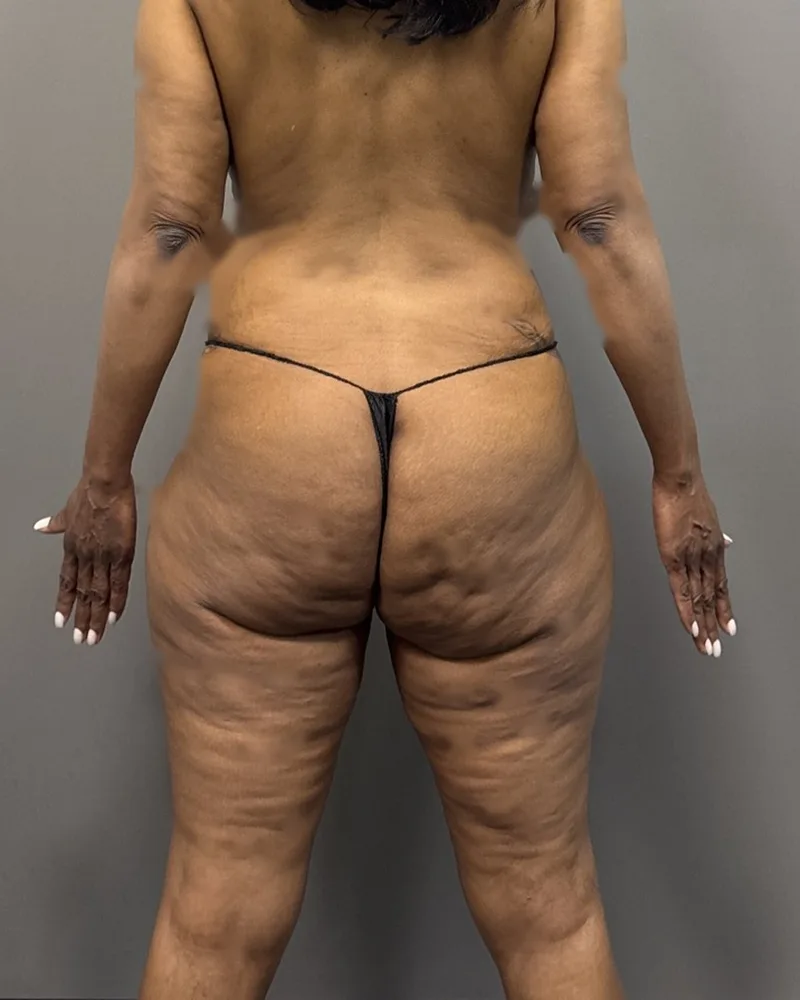 Before
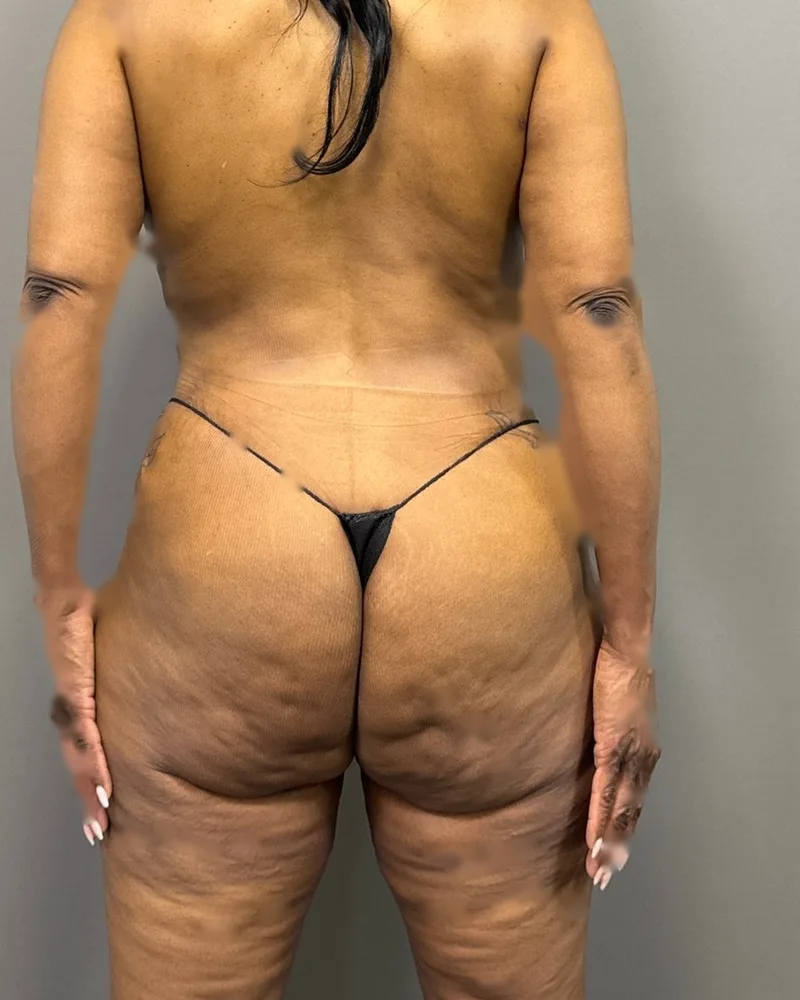 After · 1 month
We show more in person, including work on body shapes closer to yours, because a public page is a small and self-selected sample. See every result we’re allowed to publish, or ask at your consultation. Individual results vary.
Asked at the desk, answered here.
Medically reviewed by Dr. Vaibhav Desai, MD. If yours is not here, call (870) 230-0844 and ask — nobody will try to book you for asking a question.
What is fat transfer?
Fat is removed from one area of your body by liposuction, purified, and placed where you want more volume. It uses your own tissue rather than an implant.
Can fat transfer replace breast implants?
It is a different procedure with a different result. Fat transfer adds volume using your own tissue and suits a modest change, limited by how much fat can be harvested and how much the tissue accepts in one session. It does not lift.
What are hip dips and can they be filled?
Hip dips are the inward curve between the hip and upper thigh. Fat can be placed to soften them where the area looks hollow rather than heavy.
Do I need enough fat somewhere else?
Yes. There has to be a donor area with enough fat to harvest. That is assessed at your consultation, and if there is not enough we will say so.
Does all the fat survive?
No. Transferred fat needs a blood supply and a proportion is reabsorbed. What remains after the first few months is generally what you keep, and how much that is varies from person to person.
How long is the recovery?
The donor area follows the liposuction recovery: swelling, bruising, soreness and fluid drainage from the incision sites in the first 24 to 48 hours, with a compression garment. The recipient area is mostly swollen, with instructions specific to where the fat went.
Does fat transfer to the breast affect mammograms?
It can show on imaging, so tell whoever performs your mammograms that you have had fat transfer. Continue with your normal screening schedule.
What does it cost?
Cost depends on the donor areas, where the fat is placed and the plan you and your physician settle on, so we quote it at your consultation rather than guessing here. Financing is available.
Why choose fat transfer over an implant?
It uses living tissue from your own body rather than a manufactured object, and the change is generally softer and more modest. The trade is that a proportion of the fat is reabsorbed, and that a second area has to be treated to harvest it.
Can fat be transferred more than once?
A second session is sometimes discussed where more of the fat was reabsorbed than hoped. It is usually not before three to six months, so you are judging a healed result rather than a swollen one.
Does transferred fat behave like normal fat?
Yes. What survives becomes part of you and responds to weight gain and loss the way the rest of your body does.
Do you offer a Brazilian butt lift (BBL)?
No. We do not perform BBL or fat transfer to the buttocks. We do offer fat transfer to the breast and hip dips, and fat transfer to the vulva.
Come in.
Or book ahead.
A consultation is a conversation, not a commitment. We'll tell you honestly what's realistic for you.
Lux Lipo · 3800B S Caraway Rd, Suite 8, Jonesboro, AR 72401